
Canterbury’s Historic Streetlights Campaign Enters Delivery Phase
The Canterbury Society has confirmed that its historic streetlights campaign is now moving into a structured delivery phase, following meetings with Kent County Council (KCC) and Canterbury City Council (CCC).
Both councils have agreed in principle that Canterbury needs a heritage lighting strategy. The Society welcomes that commitment, because it creates a route to consistent decisions for the historic core, based on clear standards rather than piecemeal change.
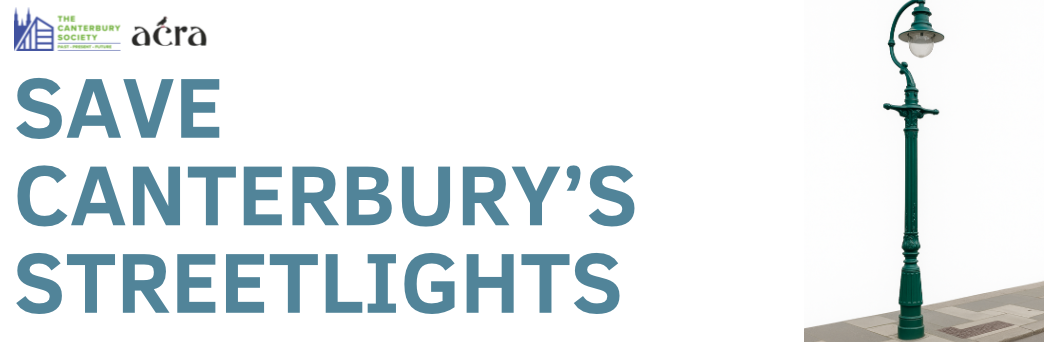
More than 3,300 people have signed the petition to protect Canterbury’s Biggleston cast-iron columns. National media coverage has brought wider attention to the issue, and correspondence released by both councils shows this has been building for years. It reflects a gap in streetscape policy, not a single recent decision.
Repair, replacement and a practical route forward
KCC’s Cabinet Member for Highways met with the Society promptly following recent coverage. KCC officers are now exploring options including specialist assessment of existing cast-iron columns, refurbishment and reinstatement where viable, and a review of moulds and designs developed through Canterbury’s Levelling Up Fund programme.
The Society has also engaged with experienced cast-iron specialists who confirm that inspection, repair and base-level intervention are normal practice in historic settings. Cast iron can corrode, but corrosion does not automatically mean failure or removal. Many heritage columns remain in service for decades where owners take a repair-first approach and maintain them properly.
The Society’s focus remains on proportionality, transparency and long-term asset management within a World Heritage setting.
A policy gap that now needs fixing
With Local Government Reorganisation approaching, Canterbury cannot rely on informal understandings or vague guidance. The current planning guidance on lighting is thin and high-level. It does not set out clear operational standards for heritage columns, materials, or like-for-like replacement. That leaves too much discretion in practice, and it drives inconsistency.
As the Society noted in its previous press statement, this issue did not start with recent removals. The Levelling Up Fund work has simply exposed the underlying weakness: highways delivery, conservation principles and public realm ambition have not been properly joined up.
This should not become a narrow technical argument. It is a chance to fix a structural problem.
The Society supports the development of a strengthened public realm framework, through an updated Supplementary Planning Document or a formal design code covering street furniture and lighting across the district. It should set clear expectations on inspection, repair-first principles, like-for-like replacement, and materials, so decisions follow policy, not default procurement.
Canterbury has a real chance to lock in a consistent approach to heritage lighting, not just pause removals.
We now need clear standards, a repair-first pathway, and a funding plan that makes the strategy deliverable.
Preserve what is sound.
Repair what can be saved.
Replace properly where loss is unavoidable.
Get Involved
The campaign is now entering mobilisation. The Society is forming small task-and-finish groups covering technical evidence, policy and design standards, funding and grants, and communications.
Residents, professionals and organisations can register to help or donate to support independent technical input and campaign delivery:
👉 Register interest in joining a working group
👉 Make a donation toward the campaign (please include ‘Streetlights’ in the order notes)
Further updates will follow as work on the proposed heritage lighting strategy progresses.
Repair-first makes complete sense
Cast iron can be repaired
You don’t just rip it out because it’s old that’s not how other historic cities manage their assets.
Thanks Alison that’s exactly the principle we’re advocating.
In many historic cities, cast-iron columns are inspected, repaired and retained wherever possible, rather than automatically replaced with inferior products. Corrosion can often be addressed through base repairs, welding and repainting, allowing columns to remain safely in service for decades to come.
The key issue in Canterbury is making sure we have a clear heritage lighting strategy and proper technical assessment so decisions are proportionate and transparent.
We’re now moving into the next phase of the campaign and will be interested to hear from volunteers and technical contributors to help support that work.
Thank you for keeping the pressure on 3000+ signatures is a great achievement. It shows people care about the detail of the city, not just the big headline projects.
Thank you Helen the level of support has been remarkable and shows that residents care about the everyday character of the city – the details that make Canterbury distinctive. Streetlights may seem small individually, but collectively they are part of the historic streetscape.
The campaign is now moving into its next phase, focusing on technical evidence, policy and funding so that the remaining columns can be properly assessed and protected for the long term.
Please keep us updated its been quite stressful watching columns disappear without explanation
Thank you Andrew we understand that many residents found it worrying to see columns removed without much public explanation, particularly after the entire street of heritage lights on (the one-way section of) Broad Street were removed in 2019.
One positive outcome of the campaign is that there is now active dialogue between Kent County Council, Canterbury City Council and heritage specialists about how the remaining historic columns should be assessed, repaired and managed.
We will continue to post updates as the work progresses and as the proposed heritage lighting strategy develops.
Looks likely I won’t have to chain myself to a lamppost ?
Let’s hope not, Richard – though it might be wise to keep the chains nearby for the moment.
We now have agreement on developing a heritage lighting strategy. The next step is making sure that translates into action.
Thank you to the society for leading this.
Did I see that as part of the new Local Plan the “albeit old/dated” SPG for Outdoor Lighting is proposed to be removed from the policy suite all together…. what is Canterbury council doing to replace it???? Do you have any update on what is proposed????